How Much Does It Cost to Build an MVP in Nepal in 2026? (Real Price Breakdown)
An honest, no-fluff breakdown of what a minimum viable product actually costs to build in Nepal — by component, by approach, and by who builds it.
TL;DR — Short answer: A focused MVP in Nepal in 2026 typically costs anywhere from NPR 50,000 (a packaged, validated, branded first build) to NPR 2–10 lakh+ for a custom, multi-platform product. The number depends on scope — branding, website, mobile app, backend, and integrations — and on who builds it. The cheapest predictable path for most first-time founders is a productized Startup Launch Program. Powered by Lacspace.

First, what an MVP actually is (and isn't)
An MVP — minimum viable product — is the smallest version of your product that real users can actually use and that proves your core idea works. It is not a half-broken prototype, and it is not the full ten-feature vision in your head. Getting this scope right is the single biggest lever on cost. (For the bigger picture, see the full guide to building a startup in Nepal.)
What actually drives MVP cost
- Scope — how many core features, and how complex each one is
- Platforms — web only, or web + iOS + Android
- Design — a template versus a real brand and custom UI/UX
- Integrations — payments (eSewa, Khalti, FonePay), maps, SMS, notifications
- Who builds it — freelancers, an agency, an in-house team, or a venture partner
Cost by component
| Component | Typical range (NPR) |
|---|---|
| Idea validation + business model | 15,000 – 40,000 |
| Branding & identity (name, logo, UI kit) | 20,000 – 80,000 |
| Marketing website | 30,000 – 1,50,000 |
| Web app (core MVP) | 1,00,000 – 5,00,000 |
| Mobile app (Android/iOS) | 1,50,000 – 6,00,000 |
| Payment + SMS + maps integrations | 20,000 – 1,00,000 |
| Launch (hosting, analytics, go-live) | 15,000 – 60,000 |
You rarely need all of these at full scope for a first MVP — a smart partner cuts the list to what proves the idea, and adds the rest after launch.
Cost by approach
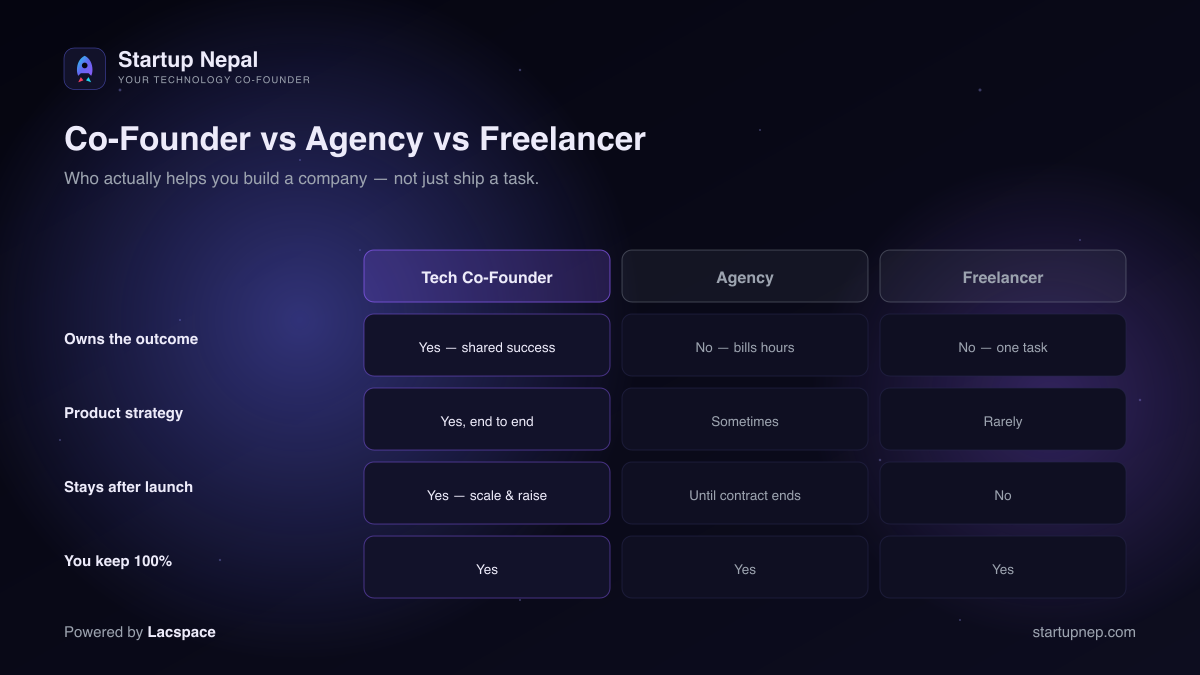
| Approach | Typical cost | The catch |
|---|---|---|
| Freelancers | NPR 1–4 lakh | Cheapest on paper, riskiest in practice; ownership and quality vary wildly |
| Agency | NPR 5–15 lakh+ | Polished build, but no validation, no launch support, build-and-disappear |
| In-house team | NPR 3–6 lakh / month | Massive burn before any revenue; hard to hire and manage as a non-technical founder |
| Startup Nepal — Launch Program | From NPR 50,000 | Validated, owned, launched — packaged tiers, or build for equity (Tech Co-Founder) |

How to keep your MVP cost down (without cutting corners)
- Cut scope, not quality. Ship the one feature that proves the idea; add the rest after real users react.
- Start web, add mobile later if your audience is reachable on the web first.
- Validate before you build. The cheapest feature is the one you didn't build because validation said no.
- Use a packaged path. A productized program gives you a fixed, transparent price instead of an open-ended hourly bill.
- Own what you build so you never pay twice to rebuild from scratch.
The Startup Nepal way
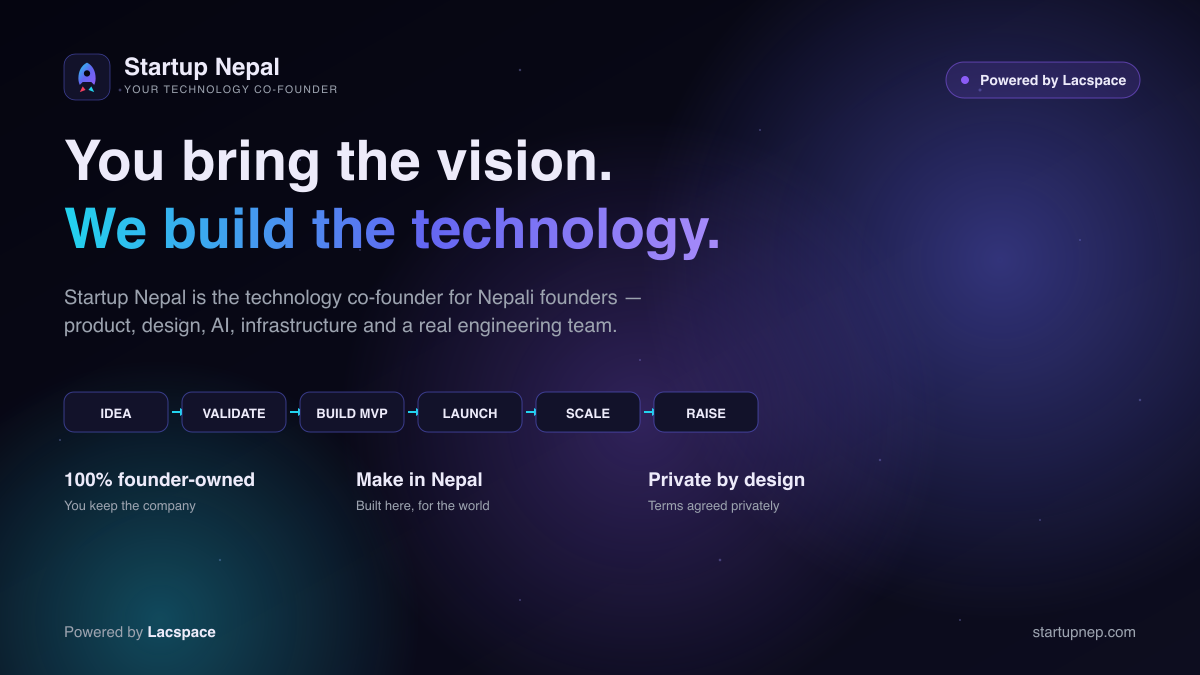
The Startup Launch Program turns the messy cost question into clear tiers — starting around NPR 50,000 to validate and brand, scaling to a full launched product with a mobile app and pitch deck. Or, if cash is the constraint, the Tech Co-Founder model lets a strong idea build for equity instead of fees.
Frequently asked questions
How much does it cost to build an MVP in Nepal?
For most founders, a focused MVP ranges from about NPR 50,000 for a packaged, validated first build to NPR 2–10 lakh+ for a custom, multi-platform product. Scope and platforms are the biggest cost drivers.
How much does it cost to build a mobile app in Nepal?
A first-version mobile app typically runs NPR 1.5–6 lakh depending on features, whether it's Android-only or cross-platform, and the integrations required (payments, maps, notifications).
What is the cheapest way to build an MVP?
The cheapest predictable way for a first-time, non-technical founder is a productized program with a fixed price and clear scope — like the Startup Nepal Launch Program from NPR 50,000 — rather than open-ended freelance or agency billing.
Can I build an MVP for under NPR 1 lakh?
Yes, for a tightly-scoped first build — validation, branding, and a focused web MVP. The key is ruthless scope: one core feature done well, with the rest added after launch.
Does the price include launch and ownership?
With Startup Nepal it does — launch support is part of the journey, and in the Launch Program and Build-for-Fee models full ownership transfers to you.
Conclusion
The honest answer to "what does an MVP cost in Nepal" is: as much as its scope — but far less than founders fear when the scope is set wisely and the price is transparent. Startup Nepal turns the guesswork into a clear NPR quote before any build begins. You bring the vision. We build the technology. Powered by Lacspace.
Get a transparent MVP quote for your idea →
— Written by the Startup Nepal team · Powered by Lacspace · Updated for 2026
Frequently asked questions
How much does it cost to build an MVP in Nepal?
A focused MVP in Nepal in 2026 typically ranges from about NPR 50,000 for a packaged, validated, branded first build to NPR 2–10 lakh or more for a custom, multi-platform product, depending on scope and who builds it.
What drives the cost of an MVP?
The main drivers are scope, platforms (web only or web plus iOS and Android), design (template versus custom UI/UX), integrations such as eSewa, Khalti, FonePay, maps and SMS, and whether freelancers, an agency, an in-house team or a venture partner builds it.
Is hiring an agency or freelancer cheaper?
Freelancers typically cost NPR 1–4 lakh but quality and ownership vary widely, while agencies cost NPR 5–15 lakh or more and often offer no validation or launch support. An in-house team costs NPR 3–6 lakh per month.
How can I keep MVP costs down?
Cut scope, not quality, by shipping the one feature that proves the idea. Start on the web and add mobile later, validate before you build, use a packaged path with a fixed price, and own what you build so you never pay twice.